

From Kimberley Station to Southeast Asian Market
The Kimberley has been moving cattle to Southeast Asian markets for decades, and Broome cattle exports have grown into one of the region’s most important supply chains. For producers across the West Kimberley, East Kimberley and Pilbara, Broome is the natural export gateway, and geography is a large part of why.
In 2025, more than 93,000 head of cattle were exported through Broome*, making it Australia’s second-largest live cattle export port. The result reflects both the strength of the northern cattle industry and the strategic role Broome plays in connecting producers with Southeast Asian markets.
Shorter Sailing Distances
Jakarta
Fremantle: 1,850 nm
Darwin: 1,600 nm
Broome: 1,350 nm
Ho Chi Minh City
Fremantle: 2,900 nm
Darwin: 2,350 nm
Broome: 2,300 nm
Manila
Fremantle: 3,000 nm
Darwin: 2,150 nm
Broome: 2,150 nm
Shorter sailing distances mean less time at sea, lower feed and water consumption on voyage, and cattle arriving at destination in better condition. For exporters, that’s a direct input into cost per head, voyage risk, and animal welfare outcomes.
For exporters, certainty matters. Vessel schedules, livestock movements and loading programs are planned well in advance, making reliable berth access a critical part of a successful export season.
Reliable, Tide-Independent Berthing
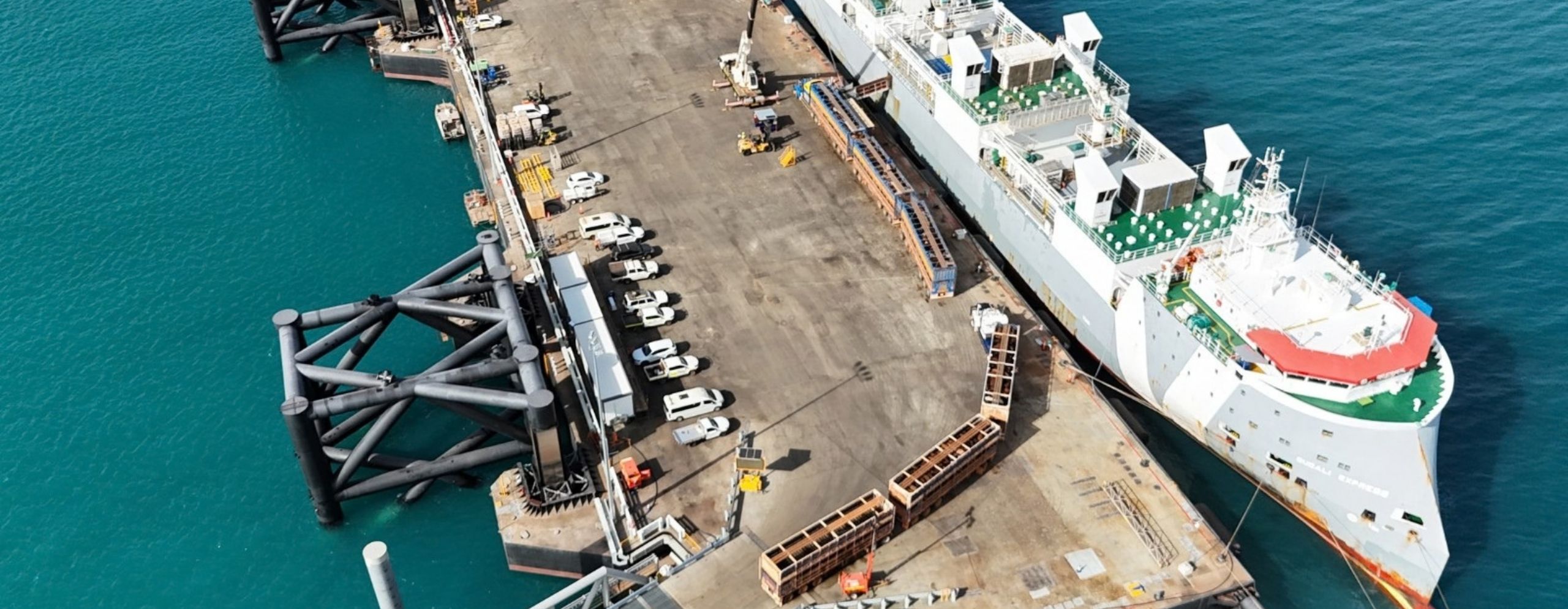
Congestion risk, tidal constraints, and competing vessel demands have historically added uncertainty to Broome’s export schedule. KMSB Terminal 2 addresses that directly, a dedicated facility within the Port of Broome, with its own deep-water berth, causeway and quayside operations.
The KMSB wharf is tide-independent. Across a 10-metre tidal range, vessels berth and load without schedule constraints, removing one of the variables that has added uncertainty to Broome’s export windows. The causeway and wharf are built to handle triple road trains at full configuration. Cattle transports drive straight to quayside and load directly onto the vessel, no breakdown to doubles required. Standard vessel services run concurrently with loading, with full-time staffing and flood lighting supporting continuous operations throughout the port call.
For exporters with vessels already working Broome, berthing at KMSB adds scheduling flexibility and reduces congestion risk during peak season when berth demand is highest and the cost of delays runs through the entire chain.
The Kimberley live export industry is growing. KMSB provides the berthing capacity, road access and 24/7 operations to support it.
*Source: Department of Agriculture, Fisheries and Forestry export statistics / Port of Broome export data (2025).
Latest Updates & Announcements
Submit Berth Application

Contact Our Team Today


